
PROFINET supports multiple topologies, including line, star, ring, and tree, offering high flexibility for industrial Ethernet network design.
Here’s a breakdown of the main PROFINET topologies and their characteristics:
Line Topology:
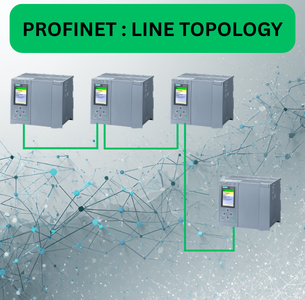
The line topology is usually used for a small Profinet network with a limited number of devices in the same enclosure or relatively near to each other, to connect devices one after the other using the devices’ integrated switches. While this choice is cost-effective, it introduces the drawback that a single device failure can cause communication to be lost. Furthermore, the number of devices on a line must not exceed the limits for the switch type and the selected Profinet update rate.
Star Topology:
In the star topology, all devices are connected to a switch, so a failure of one device does not affect the rest of the network, except when the switch itself fails. It is recommended to use a managed switch instead of an unmanaged one, as the managed switch’s integrated web server makes troubleshooting easier and can be queried via Profinet to read each port’s errors, statistics, and the names of the connected devices. The star topology requires more cabling and a central switch, which makes it relatively more expensive than a line topology.
Ring Topology:
In a ring topology, devices are connected one after the other in a closed loop, allowing redundancy if the loop is broken at any point. The number of devices is limited to 50, and communication may be lost if Profinet RT and applications do not tolerate the recovery/reconfiguration time <200ms. Profinet IRT doesn’t require a recovery/reconfiguration time, and a single point line break doesn’t cause a loss of communication.
Profinet RT requires a Media Redundancy Manager (MRP) and the other ring devices to be set as Media Redundancy Clients (MRC).
Profinet IRT in a ring topology uses Media Redundancy for Planned Duplication (MRPD).
The ring topology introduces more configuration complexity.
Tree Topology:
The tree topology is based on several star topologies, where each end of the star can be the beginning of another star network. It is usually used for large-scale networks to organize and connect manufacturing cells or plant areas. It is recommended to use transceivers and cabling that support 1000 Mbps or higher between the tree-branch switches.